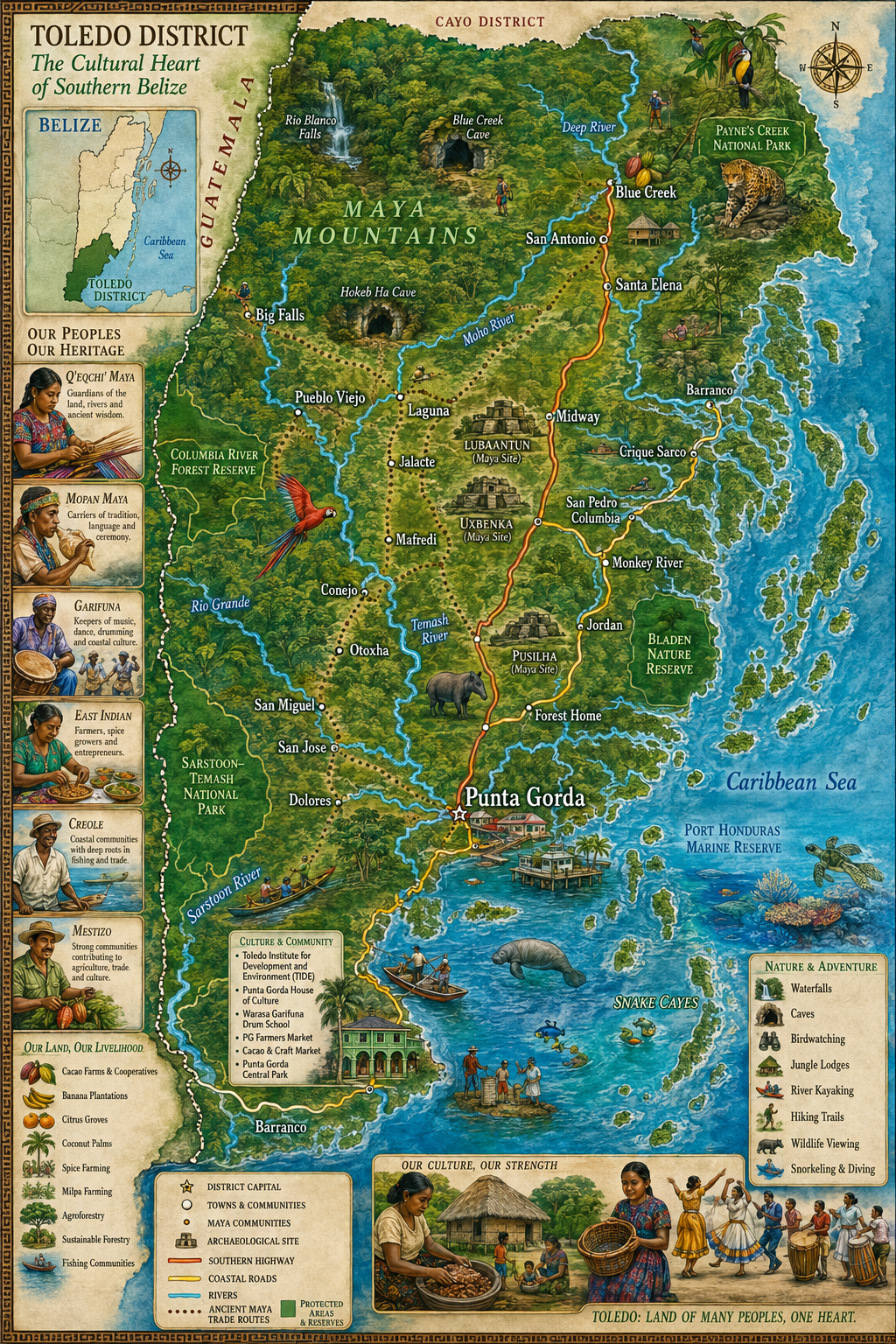
Toledo is Belize’s southernmost district, bordered by Guatemala, the Caribbean Sea, and some of the country’s richest rainforest, river, cave, and coastal ecosystems. Punta Gorda, often called “PG,” is the district capital and the main gateway to southern Belize. Toledo is also the least populated district in Belize, with a strongly rural character and many small villages connected by the Southern Highway, feeder roads, rivers, and community tourism networks. Recent subnational HDI listings group Stann Creek and Toledo together as Belize’s second-highest HDI region, so it is more accurate to say that Toledo is part of the country’s second-ranked HDI subregion rather than Toledo alone being ranked separately.
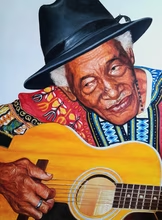
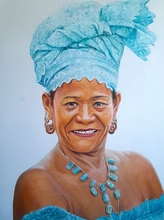
Culturally, Toledo is one of the most diverse and distinctive parts of Belize. It is especially known for its Q’eqchi’ and Mopan Maya communities, many of which maintain living traditions of farming, weaving, foodways, language, spirituality, and village-based community life. Garifuna culture is also important, especially in Punta Gorda and Barranco, the historic home village of musician and cultural icon Andy Palacio. Creole, East Indian, Mestizo, Mennonite, and other communities also contribute to the district’s food, language, music, markets, and religious life. Visitors often experience Toledo through village stays, drumming, traditional Maya cooking, cacao farm tours, craft demonstrations, and local markets rather than through large resorts.
Toledo’s cultural attractions are closely tied to its communities and landscapes. Punta Gorda’s seafront, market, small restaurants, and local craft shops make it a relaxed cultural base for exploring the district. Inland villages such as San Antonio, San Pedro Columbia, Blue Creek, Indian Creek, and Santa Cruz offer access to Maya culture, caves, rivers, farms, and archaeological sites. Coastal and marine attractions include Port Honduras Marine Reserve and the offshore cayes, while inland natural attractions include Rio Blanco National Park, Blue Creek Cave, waterfalls, rainforest reserves, and river systems that support fishing, farming, and ecotourism.
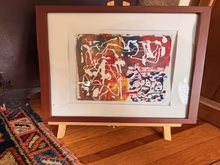
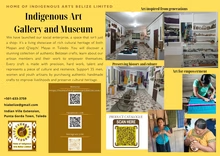
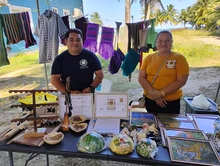
In 2025, Punta Gorda added an important new cultural attraction with the opening of its first Art Gallery and Museum focused on Indigenous women’s craft and cultural heritage. The museum was launched by Home of Indigenous Arts Belize Limited, an organization that supports Indigenous artisans through training, marketing, cultural preservation, and livelihood development. The new space showcases handmade clothing, baskets, jewelry, and other works by women artisans from southern Belize, creating a permanent venue where visitors can learn about Maya and Indigenous artistic traditions while directly supporting local makers. It also strengthens Toledo’s role as one of Belize’s most important centers for community-based cultural tourism and living heritage.
The district is also rich in Maya archaeology. Lubaantun, near San Pedro Columbia, is one of the best-known sites in southern Belize and is famous for its finely fitted stone construction, plazas, and ball courts. Nim Li Punit, near Indian Creek Village, is known for its carved stelae, including one of the tallest carved stelae found in Belize. Other important Toledo archaeological sites include Uxbenká, one of the earliest known Maya centers in southern Belize, and Pusilhá, an important Classic-period Maya center. Together, these sites show that Toledo was not a remote backwater of the Maya world, but a region with major political, ceremonial, agricultural, and trade activity.
Agriculture remains central to Toledo’s identity. The district is especially associated with cacao, much of it grown by Maya farmers and used by Belizean chocolate makers. Toledo’s cacao industry is celebrated through farm tours, chocolate-making demonstrations, and the annual Chocolate Festival of Belize. Other important crops and food traditions include corn, rice, beans, plantains, cassava, citrus, coconuts, tropical fruits, spices, and small-scale livestock. Farming in Toledo is not only an economic activity but also a cultural foundation, especially in Maya communities where milpa agriculture, home gardens, traditional foods, and seasonal planting cycles remain important.
Festivals in Toledo reflect this blend of agriculture, culture, music, and community life. The Chocolate Festival of Belize, held around Commonwealth weekend in May, is the district’s best-known annual event, celebrating cacao, chocolate, Maya culture, local food, music, arts, and crafts. Garifuna Settlement Day on November 19 is also observed in southern Belize, with drumming, dancing, traditional foods, and cultural ceremonies. Village fiestas, church celebrations, market days, and cultural programs throughout the year add to Toledo’s appeal as one of Belize’s strongest regions for community-based cultural tourism.
Sources
Belize Tourism Board / Travel Belize — Chocolate Festival of Belize; Things to do in Punta Gorda.
National Institute of Culture and History — Nim Li Punit archaeological site.
Global Data Lab / Subnational HDI listings — Belize district HDI groupings.
Belize.com — Toledo District and Toledo Chocolate Festival.
Viaventure — Toledo, Punta Gorda & community tourism.
ResearchGate / archaeology research references — Uxbenká and southern Belize archaeology.
Home of Indigenous Arts Belize Limited — information on the organization’s mission to support Indigenous artisans, cultural preservation, training, and sustainable livelihoods.
Breaking Belize News — report on Punta Gorda’s first Art Gallery and Museum showcasing Indigenous women’s craft, opened September 30, 2025.
The Reporter Belize — coverage of Punta Gorda’s new Art Gallery and Museum and its collection of handmade works by 22 women artisans.